




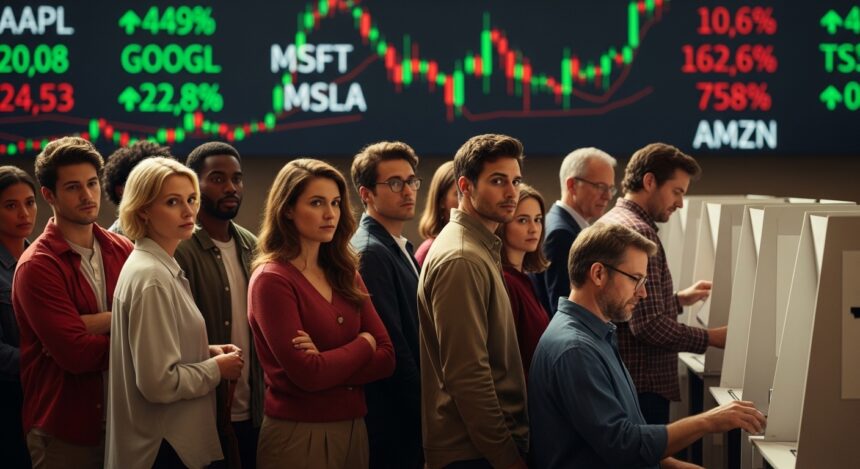
Pocketbook Politics: How Elections and Their Economic Impact Affect You
Elections and their economic impact ,Let’s be honest: when election season rolls around, it’s easy to get caught up in the drama. The attack ads, the catchy slogans, the late-night debate memes—it can feel like a spectator sport. But underneath all the noise, there’s a serious question that every voter is quietly asking themselves: “Will I be better off financially after this election?”
Whether it’s a local mayor’s race or a massive national presidential contest, the connection between who wins and what happens to your wallet is real. Understanding this link between elections and their economic impact isn’t about partisan politics. It’s about being a smart citizen who can see through the campaign promises and understand what might actually happen next.
In this article, we’re going to pull back the curtain. We’ll look at how markets react to election results, why your grocery bill might be tied to a policy debate, and how you can prepare for the financial shifts that often follow a trip to the voting booth.
The Great Unknown: Why Elections Create Economic Jitters
Imagine you’re driving a car, but the GPS keeps flickering on and off. You’d probably slow down a bit, right? That’s exactly what happens to the economy during an election cycle. Businesses and investors hate one thing above all else: uncertainty.
The “Wait and See” Game
Before an election, especially a close one, the business world often hits the pause button. Companies might hold off on hiring new staff or delay building that new factory. Why? Because they don’t know what the rules of the game will be in six months.
- Will the next government raise corporate taxes?
- Will they loosen regulations on your industry?
- Will they sign new trade deals or tear up old ones?This uncertainty is like sand in the gears of the economy. It slows things down.
We saw this clearly in the run-up to the 2020 US Presidential election and the 2016 Brexit referendum. Investment slowed, and businesses stockpiled cash, waiting for clarity. This pre-vote slowdown is one of the most predictable examples of elections and their economic impact on short-term growth.
The Market Rollercoaster: Stocks, Bonds, and Ballots
If you have a retirement fund or any money in the stock market, you’ve probably noticed it gets bumpy around election time. Financial markets are essentially massive prediction machines, and they react to political news in real-time.
The Initial Reaction (Often Emotional)
When the results start coming in, the first market moves are usually based on emotion and surprise. Did the favorite win? Was it a landslide or a photo finish? A shock result—like an unexpected victory for a candidate with radical policies—can cause a temporary market “panic sell-off.”
Remember the night of the Brexit vote in 2016? As it became clear the “Leave” campaign would win, the British pound crashed to a 31-year low. It was a raw, emotional reaction to an unexpected outcome.
The Calm After the Storm
Here’s the thing most beginners don’t realize Elections and their economic impact: markets usually calm down pretty quickly. Once the dust settles, investors stop reacting emotionally and start analyzing. They look at the new government’s actual policies.
A market might initially drop because a “business-unfriendly” candidate wins. But if that candidate inherits a strong economy or faces a gridlocked Congress (meaning they can’t pass drastic laws), the market might actually recover and start climbing. The long-term trend is dictated by policy, not just the winner’s name.
Policy Promises vs. Economic Reality
This is where things get really interesting. During a campaign, candidates promise the moon. Free college! Massive tax cuts! A wall paid for by someone else! But there’s a massive gap between a campaign promise and an implemented policy.
The Check and Balance System
In many countries, the winner doesn’t get to do whatever they want. In the US, the President proposes, but Congress disposes. If the winning candidate’s party doesn’t control the House and Senate, they face gridlock. Paradoxically, gridlock is often loved by investors because it means no big, disruptive changes are coming. The economy just chugs along on autopilot.
The Implementation Lag
Even if a party sweeps into power with full control, policies take time to implement.
-
A new tax law might not take effect until the next fiscal year.
-
A massive infrastructure spending bill might take years to award contracts and break ground.
So, the economic impact you hear pundits screaming about on TV might not actually hit your paycheck for two or three years. By then, it’s time for the next election!
Three Key Areas Where Elections Hit Your Wallet
Let’s get specific. Forget the abstract talk of “market confidence.” Here’s how election outcomes directly affect your day-to-day life.
1. Your Taxes
This is the most direct link. One party typically wants to lower taxes (especially on corporations and high earners) to stimulate investment. The other typically wants to raise taxes (especially on the wealthy and corporations) to fund social programs like healthcare and education.
-
What to watch: Pay attention to debates about income tax brackets, corporate tax rates, and estate taxes (sometimes called the “death tax”). A change here directly impacts your take-home pay or the value of what you pass on to your kids.
2. Your Job and Industry
Different industries thrive under different governments.
-
Green Energy: A government focused on climate change will pour subsidies into solar, wind, and electric vehicles. Jobs in those sectors boom.
-
Oil and Gas: A government focused on “energy independence” and deregulation will boost traditional fossil fuel industries.
-
Tech and Pharma: Debates around antitrust laws (breaking up big companies) and drug pricing controls can shake up the tech and pharmaceutical sectors, affecting job security and stock prices.
3. The Cost of Stuff (Inflation)
Government spending is a huge driver of inflation. If a new government goes on a spending spree—building bridges, sending out stimulus checks, increasing social benefits—they pump a lot of money into the economy. While that helps some people short-term, it can lead to higher inflation if the supply of goods doesn’t keep up. You feel this as higher prices at the grocery store and the gas pump.
Case Study: The “Trump Bump” and the “Biden Boom” (Simplified)
Let’s look at a recent, real-world example to make this concrete. We’ll simplify it for clarity.
-
2016 Election (Trump): When Donald Trump won, the market initially dipped overnight, then roared back. Why? He promised massive corporate tax cuts and deregulation. Investors saw higher future profits and bought stocks. This was dubbed the “Trump Bump.” The tax cuts he signed in 2017 did lead to a period of strong economic growth and low unemployment (until the pandemic hit).
-
2020 Election (Biden): When Joe Biden won, markets were initially happy about the end of election uncertainty but worried about potential tax hikes. However, his administration pushed through massive spending bills focused on infrastructure and green energy. This pumped money into specific sectors. While growth continued, some economists argue these spending packages contributed to the inflation spike that followed.
The key takeaway? Different candidates create different winners and losers in the economy. Your personal experience depends heavily on what industry you work in and how you earn your money.
Practical Tips: Protecting Your Finances During Election Season
So, how do you navigate this? You don’t need to be a Wall Street trader to protect yourself during these volatile periods. Here are a few down-to-earth tips.
-
Don’t Make Drastic Moves Based on Headlines: This is the golden rule. If you have a well-diversified, long-term investment portfolio (like a 401k), do not empty it because your least favorite candidate wins. History shows that timing the market based on politics is a fool’s errand. Stay the course.
-
Look Local, Not Just National: A presidential election gets the headlines, but your local mayor or city council often has a bigger impact on your property taxes, local schools, and the potholes on your street. Pay attention to those races too.
-
Watch the “Spread the Wealth” vs. “Free the Market” Debate: Listen to the core philosophy of the candidates. Do they want to use government money to help specific groups (students, homeowners, the poor)? That’s a “spread the wealth” approach. Do they want to cut taxes and regulations so businesses can grow and hire? That’s a “free the market” approach. Figuring out which philosophy a candidate holds helps you predict their actions better than any single promise.
-
Diversify Your Income: If you’re worried about policy changes in your industry, consider building a side hustle or investing in different sectors. If you work in oil and gas, maybe put some savings into a green energy ETF. This hedges your bets.
The Verdict: Politics Matters, But It’s Not Everything
It’s easy to fall into the trap of thinking that if “our guy” loses, the economy is doomed, or if “our guy” wins, we’re headed for utopia. The reality is much more nuanced.
The economy is a massive, complex machine driven by millions of factors: global events, technological innovation, consumer confidence, and yes, government policy. Elections set the rules of the road, but they don’t control every single driver on the highway.
Understanding elections and their economic impact helps you become a more informed voter and a more level-headed investor. You stop reacting to the scary TV commercials and start thinking critically about the future.
Next time you walk into that voting booth, think about your wallet. But also think about your neighbors, your community, and the kind of world you want to live in. The best financial decision is often the one that balances personal gain with the long-term health of the society we all share.
Frequently Asked Questions
Q: Should I sell my stocks before an election if I’m nervous?
A: Generally, no. Trying to time the market is incredibly difficult, even for professionals. If you sell and the market goes up, you lose money. If you hold and it drops, it will likely recover over time. A diversified, long-term portfolio is built to weather political storms. Consult a financial advisor, but the mantra is usually “time in the market, not timing the market.”
Q: Do elections cause inflation?
A: They can contribute to it. If a new government implements massive spending programs (stimulus, infrastructure) without corresponding increases in production, it can overheat the economy and lead to inflation. However, inflation is also caused by global supply chain issues, energy prices, and central bank policies, which are often independent of the government.
Q: How quickly do new economic policies take effect after an election?
A: It varies. Some things, like executive orders on energy leasing, can happen immediately. Others, like major tax reform, can take months or even a year to negotiate and implement. Don’t expect your paycheck to change the day after the election.
Q: Does it matter if my country has a divided government?
A: Yes, a lot. A divided government (e.g., a President from one party and a Congress controlled by another) usually leads to gridlock. This means fewer major policy changes. For investors, this predictability can actually be a positive thing, even if it means less dramatic action.
Q: Are the economic promises made during campaigns realistic?
A: Often, no. Campaign promises are designed to get votes, not necessarily to pass a cost-benefit analysis from the Congressional Budget Office. They are a statement of intent, not a binding contract. It’s wise to be skeptical and look at a candidate’s broader philosophy rather than their specific, flashy promises.