



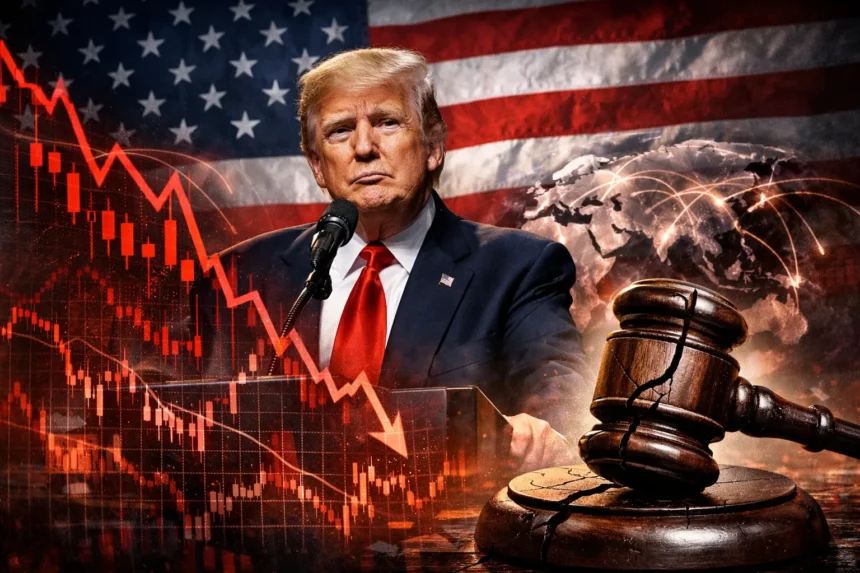
In a major development shaping U.S. economic policy and global trade tensions, President Donald Trump sharply condemned a recent U.S. Supreme Court ruling that struck down the core of his sweeping global tariff program, calling the decision “extraordinarily anti-American.
The court’s 6-3 judgment found that Trump had exceeded his legal authority by using a 1977 emergency economic powers law to impose broad tariffs on dozens of countries, underscoring a constitutional check on executive power and reinforcing that trade policy — including tariffs — ultimately belongs to Congress.
The Guardian
Rather than backing down, Trump responded by raising a new set of global import duties to 15%, exploiting a different statute that allows presidents to address balance-of-payments issues. While this move intends to preserve his protectionist agenda, it also deepens legal and economic uncertainty at home and abroad.
Political & Economic Analysis
🔹 Domestic Politics
Trump’s attack on the Supreme Court — labeling the decision “anti-American” — reflects a broader strategy to solidify his support among his political base by framing the judiciary as antagonistic to his policies. Critics argue this rhetoric undermines institutional norms and fuels polarization, potentially weakening independent branches of government.
🔹 Policy Implications
By pivoting to a new tariff mechanism, Trump seeks to maintain an aggressive trade stance. But legal challenges remain, with some experts already asserting that the new tariff approach could also be vulnerable to judicial scrutiny.
🔹 Economic Impact
The Supreme Court’s decision may provide relief to American consumers and businesses by reducing cost pressures from earlier tariffs — but Trump’s policy shift keeps significant trade barriers in play. According to financial analysts, refunding previously collected tariffs could inflate the federal deficit and reshape markets, while ongoing tariff uncertainty weighs heavily on international trade relationships.
🔹 Global Relations
Allied nations — particularly in Europe and Asia — have reacted with concern, as unpredictable trade policy and escalating tariffs risk retaliation or slower economic cooperation. blog, your email signup page, your product listings, pricing, contact information, or help docs.
In a dramatic escalation of tensions between the executive branch and the judiciary, Donald Trump has condemned a recent Supreme Court of the United States ruling that struck down key components of his tariff program, calling the decision “extraordinarily anti-American.”
The ruling limited the president’s authority to impose sweeping tariffs under emergency economic powers. Rather than retreating, Trump announced a revised strategy — implementing a 15% global import tariff under a different legal justification.
This development is not merely a trade policy adjustment. It is a constitutional, political, and economic flashpoint with wide-ranging implications.
1️⃣ Constitutional & Institutional Impact
Separation of Powers Debate
The Court’s decision reinforces a foundational principle of the U.S. system:
Congress controls trade and taxation policy, not the president alone.
This ruling:
- Reasserts legislative authority.
- Limits executive overreach.
- Reinforces judicial oversight in economic policymaking.
However, Trump’s sharp public criticism of the judiciary raises concerns about:
- Erosion of institutional trust.
- Escalating executive-judicial confrontation.
- Increased political polarization.
When a president publicly frames a court decision as “anti-American,” it shifts the debate from legal interpretation to ideological conflict.
2️⃣ Political Strategy & Electoral Calculations
From a political standpoint, this move aligns with Trump’s long-standing “America First” economic nationalism.
Why This Plays Well Politically:
- Protectionist messaging appeals to manufacturing-heavy states.
- It reinforces an image of strength against foreign competitors.
- It energizes voters who distrust globalization.
Risks:
- Alienates business conservatives.
- Raises prices for consumers.
- Invites backlash from trade partners.
In election dynamics, this issue could become a defining economic narrative — protectionism vs. institutional stability.
3️⃣ Economic Effects — Short & Long Term
Short-Term Effects:
- Market volatility.
- Supply chain uncertainty.
- Rising import costs.
Consumer Impact:
Tariffs function as indirect taxes. Businesses often pass costs onto consumers, meaning:
- Higher prices on electronics, vehicles, machinery.
- Increased production costs for small businesses.
- Inflationary pressure in sensitive sectors.
Federal Budget Implications:
If previously collected tariffs are refunded due to legal reversal:
- Federal deficit could widen.
- Administrative complexity increases.
Long-Term Structural Risk:
Persistent tariff uncertainty discourages:
- Foreign investment.
- Long-term manufacturing planning.
- Stable trade agreements.
4️⃣ Global & Geopolitical Repercussions
This move affects America’s diplomatic posture.
Europe & Asia:
Allied economies may:
- Consider retaliatory tariffs.
- Challenge policies in international trade forums.
- Diversify trade away from U.S. dependency.
China Factor:
Although not exclusively targeted, China remains central to tariff politics.
Escalation could:
- Reignite trade war dynamics.
- Reshape supply chains further.
- Accelerate economic decoupling.
5️⃣ Legal Future: Is This Over?
Likely not.
Legal experts suggest:
- The new 15% tariff framework could also face court challenges.
- Businesses may sue for damages.
- Congress may intervene legislatively.
This could evolve into a prolonged constitutional struggle defining executive trade authority for decades.
6️⃣ Institutional Confidence & Public Perception
Polls already show growing public skepticism about:
- Checks and balances functioning properly.
- Political neutrality of institutions.
If tensions between executive and judiciary intensify, it may:
- Deepen ideological divides.
- Normalize confrontational rhetoric toward courts.
- Weaken public trust in governance systems.
7️⃣ Strategic Interpretation (Mature Tajziya)
This episode reveals three deeper realities:
🔹 1. Executive Power Expansion Is Being Tested
The presidency increasingly operates at the edge of statutory authority. Courts are now recalibrating those limits.
🔹 2. Economic Nationalism Is Structurally Embedded
Tariffs are no longer temporary tools — they are political identity markers.
🔹 3. Institutional Stress Is Growing
When branches of government publicly clash, governance becomes more transactional and less stable.
Why This Story Matters
This is not just about tariffs.
It is about:
- Constitutional boundaries.
- Institutional legitimacy.
- Global economic alignment.
- Electoral strategy.
- The future of U.S. trade leadership.
The coming months will determine whether this becomes
Lorem ipsum dolor sit amet, consectetur adipiscing elit. Ut tincidunt, nisi vitae accumsan interdum, dolor turpis dignissim nibh, nec mollis tellus lorem id justo.
Sed luctus dolor ac velit scelerisque, quis convallis sem commodo. Curabitur iaculis velit nec ligula pulvinar, quis gravida arcu euismod.
Donec commodo vel turpis quis malesuada. Donec ac purus viverra, sagittis erat quis, interdum erat. Maecenas tempus eget nulla ac lobortis.
Nullam id hendrerit massa. Nullam eros nulla, convallis vitae tempus in, pharetra vel odio. Phasellus sem purus, rhoncus a erat sed, aliquam tempus sem.